
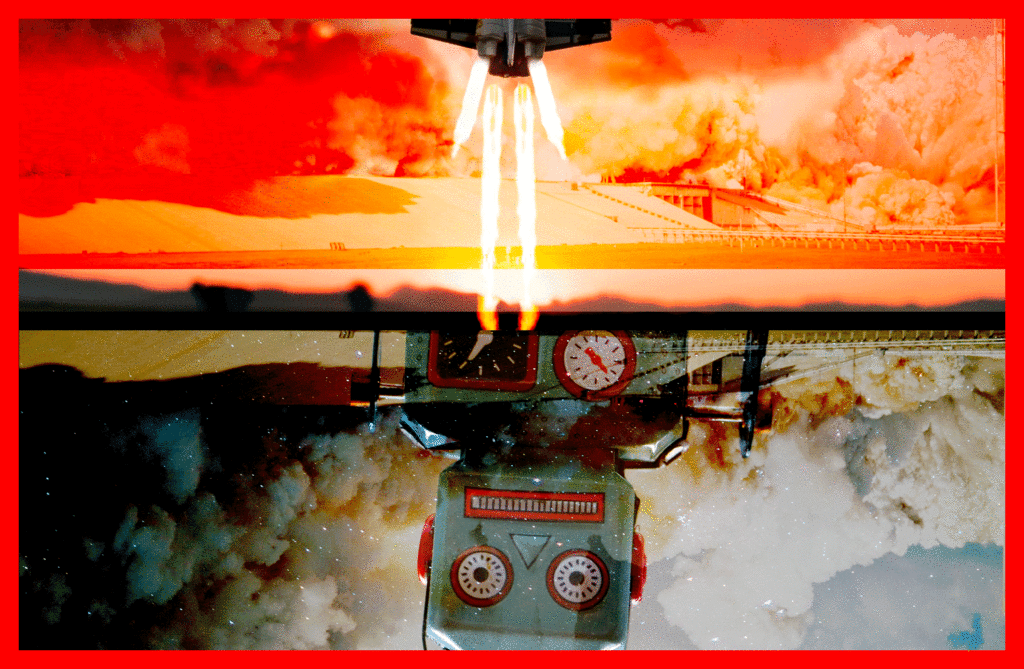
I recently rewatched a movie I saw a long time ago called WALL-E. I used to really enjoy this Disney-Pixar movie, but today I saw it with fresh eyes. Now I can see it for what it is – this movie is very unbiblical and ungodly. It offers a false theology that makes technology the savior. Here is a summary of the movie.
This animated film takes place in a dystopian and hopeless future (IMDb, n.d.). At that time, the Earth had become an uninhabited wasteland due to consumerism and the waste produced by a megacorporation named Buy n Large. The toxic atmosphere and mountains of trash forced mankind to evacuate on a massive spaceship to ensure the species’ survival. Then, what was originally intended to be a short trip turned into a 700-year exile in space since the plant failed to recover as the scientists had hoped. This is the movie’s backstory.
As many movies have different timelines, the “current” timeline of the movie starts off by detailing a small waste-collecting robot named WALL-E. This tiny robot spends his days cleaning a deserted, trash-covered Earth with his close friend, a cockroach. Wall-E has many anthropomorphic qualities, including a lonely daily routine. In the story, WALL-E’s daily life is interrupted by the arrival of EVE, a sleek female robot probe sent from the exiled spacecraft to search for life on the old planet. WALL-E is quickly attracted to EVE and subsequently follows her into deep space. The journey leads the pair back to the Axiom, the last remaining spaceship from the original fleet, where the remnants of humanity have lived for the last 700 years (Pixar Wiki, n.d.).
In the movie, the leader of the ship, a Captain named McCrea, likes the simplicity of automation and likes to follow a simple routine. McCrea does what he is told, and he follows all of the instructions of his AI robot first captain on the ship named AUTO. That is until he learns about life on Earth. Ordinarily Captain McCrea would do what AUTO told him to do until one day, he decided he wanted to return the spaceship to Earth and rehabilitate the planet. However, AUTO does not want to return to Earth, and McCrea has to outwit AUTO, which ultimately ends in mutiny.
Then, AUTO and McCrea engage in a struggle to reclaim control of his ship. Simultaneously, WALL-E and EVE fight to protect the small plant that proves life can persist on planet Earth. Ultimately, their bravery inspires humans to unplug from their screens. (Which, by the way, the people in this movie are depicted in an almost vegetative state, always using a screen device.) In the end, the ship ultimately returns to Earth because EVE successfully triggers a sensor using the seedling from Earth that indicates the soil is once again sustainable for life. This discovery fulfills the ship’s “Operation Recolonize” protocol, despite AUTO’s failed attempts to suppress the possibility. Then, Captain McCrea overrides the autopilot controls and steers the ship back to its home port.
Upon landing, the world is still dusty and scarred, but quickly, plants begin to grow. Thus fulfilling the original directive for a fresh start on the earth. The movie ends with a new future, one in which mankind and robots work together to restore the beauty of the natural world.
As you can see, everything seems harmless at first glance when you watch this movie with a cursory view. The movie’s apparent themes glamorize unity to overcome challenges. But underneath this charming surface are some more inherently dangerous themes I will explore, beginning with an antichrist theme.
Peculiar Antichrist-like Themes found in the WALL-E Movie
The movie, in a very subtle way, tries to normalize a society with a one-world government. Off the cuff, this may not seem like a big deal. However, in the end times, as described in Revelation 13, we learn that there will be a one world government and an antichrist who enacts as a global dictator. For the movie to go this direction is troublesome. The storyline introduces a one-world leader early in the movie who decided to move everyone on earth into spaceships to save humanity, like the Axiom. And this took place 700 years before the movie. The person who decided to do this was “Shelby Forthright,” who was the CEO of the Buy n Large (BnL) corporation. In the movie, the BnL company was the world’s largest. As the leader of the largest company, Mr. Forthright was the world government leader at the time, 700 years prior. Later, in the movie’s timeline, there is again a singular leader. The captain, Captain McCrea, who in the movie is the last remaining human leader, is from a successive fleet of ships. This singular human leader apparently makes all the decisions in the movie, but really, the robot with AI, named AUTO, did all the real thinking, strategizing, and planning. This reinforces the drive for the singularity with machines and the concept that the true leader of the antichrist system is unseen.
The Representation of a False Theology of Salvation through Technology and Transhumanism
The movie also threads a clear, false theme of salvation through technology. In the movie, Wall-E and Eva, who are both robots, save the “World.” Although the “World” we know no longer exists, the world is in an ark of sorts, a spaceship called the Axiom. Like Noah’s Ark, this ship also carries the last of the human race. It serves as a lifeboat for humanity, keeping them safe in space until the “waters,” portrayed in the movie as the toxic environment on Earth, recedes.
The theme of “salvation with technology” is also presented in the movie’s closing credits, where the viewer is given an executive summary of the script, told through ancient cultural imagery. First, the viewer sees hieroglyphic-like imagery from ancient Egypt, which tells the Wall-E story; then the viewer is presented with imagery synonymous with ancient Greece to continue the story. As the viewer is moved through time, clearly depicting several key human societies, like the first two examples, the story closes with the blueprints for the spaceship. In this final imagery, it also quickly reiterates some of the key relationships among the main characters in the movie’s storyline. This prompts the viewer to recognize that technology has a religious quality and serves as a form of salvation for humanity (Burdett, 2014, p. 60). Transhumanism is defined by Nick Bostrom as:
“The intellectual and cultural movement that affirms the possibility and desirability of fundamentally improving the human condition through applied reason, especially by developing and making widely available technologies to eliminate aging and to greatly enhance human intellectual, physical, and psychological capacities.” (Burdett, 2014, p. 81). With this definition in place, there is a moment of transhumanism at the end of the movie when Wall-E reboots. When he restarts, he ceases to remember his connection to EVA, and all his thoughts and memories are momentarily lost. Suddenly and unexpectedly, his memories are restored, reinforcing the transhumanism agenda.

Scarcity and Fearmongering
The final theme worth identifying in the movie is scarcity. Scarcity is defined simply as the fear of not having enough. The scarcity in the movie is a lack of living plants. Scarcity is always associated with fear. Fear is a Luciferian agenda that has an antithesis of peace that only Christ can provide. The devil always brings fear with a primary goal of stealing, killing, and destroying (John 10:10). In the Devil’s economy, there’s never enough for anyone, which is the exact opposite of the Lord’s economy. In Christ’s Kingdom, there is always an opportunity for salvation, complete restoration, equality, and advancement as long as we are alive until the moment we take our last breath. In the movie, human civilization exhausts all plant life and succumbs to a scarcity mindset.
Conclusion
The Disney-Pixar film WALL-E promotes a false theology. The movie projects that humanity is saved which technology, rather than the Lord Jesus Christ, which is a form of a debased mind (Romans 1:28). The movie contends that the 700-year exile in space is reasonable as well as presenting audiences with several “antichrist” themes to conform and condition viewers to accept the antichrist in the future. Not to mention, the entire premise of the movie is unfounded and untruthful, as space travel is not possible under a “firmament” which is an impermeable “terrible crystal” (Ezekiel 1:22; Genesis 1:6–8). Space travel is merely a Hollywood production, see my post: The Terrible Crystal: Biblical Cosmology in the Modern Era – Thaddaeus Dachille.
But beyond this point, I see this “children’s movie” not as a simple story but rather as a complex propaganda vehicle. This movie, no different from any of the other propaganda devices, is not harmless but a means to normalize the rise of the antichrist, transhumanism, and a belief system where mankind and machines provide their own redemption.

References:
Burdett, M. S. (2014). Eschatology and the technological future. Routledge.
IMDb. (n.d.). WALL·E. Retrieved October 24, 2023, from https://www.imdb.com/title/tt0910970/
Pixar Wiki. (n.d.). WALL•E. Fandom. Retrieved February 8, 2026, from https://pixar.fandom.com/wiki/WALL%E2%80%A2E