
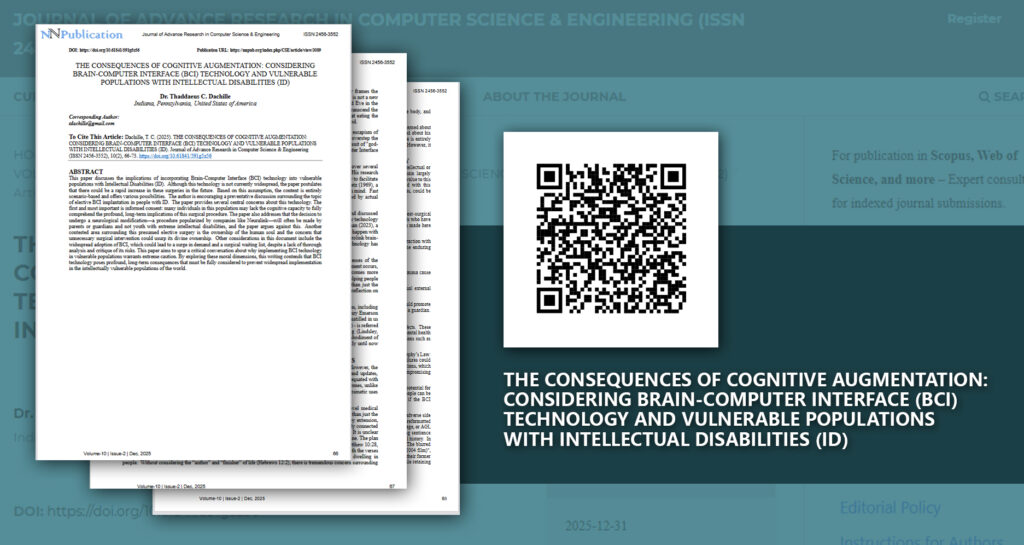
The human desire to transcend all limitations and be “god-like” is not a modern phenomenon but a longstanding temptation, as seen in Adam and Eve’s decision to take and eat the fruit in the Garden of Eden. This was in direct defiance of the Lord God, and in this decision, they chose to be all-knowing, and it cost them and humanity everything. (That is, until Christ paid the full price some 2,000 years ago on the cross.) However, this seemingly perpetual desire for greater intellectual ability is a recurring theme. We are seeing it happen once again in the movement towards BCI Technology. In my latest paper, “THE CONSEQUENCES OF COGNITIVE AUGMENTATION: CONSIDERING BRAIN-COMPUTER INTERFACE (BCI) TECHNOLOGY AND VULNERABLE POPULATIONS WITH INTELLECTUAL DISABILITIES (ID),” I look into this topic from a biblical standpoint to see this topic for what it is, a newfound promise to fulfill this ancient desire to enhance our cognitive ability.
As a perpetual desire to be god-like, companies like Neuralink are popularizing the idea of neurological implants as a means to be all-knowing. Although this technology is not yet widespread, the trajectory of incorporating BCI implants with elective surgery in the coming years could be a very real possibility, driven by the promise of making technology easy to install and seamless to operate. However, the advanced intellectual gains and mental abilities will have a cost, and this paper considers that cost.
Some of the themes addressed in the paper include, but are not limited to:
- The Demonic Window: Principalities and Powers could enter via the BCI Technology
- The Mechanics of Spiritual Intrusion
- Health, Safety, and the Risks of Digital Dependency
- The Problem of Consent in Vulnerable Populations
- The potential harm to the Body, Soul, and Spirit
- Prophetic Implications and Modern Alignments
- Toward a Preventive Ethics
Here is an overview of each of the sections described above:
The Demonic Window: Principalities and Powers could enter via the BCI Technology
A primary concern of this viewpoint article is the potential for demonic intrusion, as a BCI could serve as a “legal” entry point for dark forces into a human host. Scripture warns believers to give no opportunity to the devil, and any opening can be exploited by the adversary. The most vulnerable individuals are the most at risk of this exploitation because the demonic realm operates through a highly adaptable, evil, organized system using a total war philosophy on humankind. In the paper, I write about Howard Pittman’s near-death experience, which provides excellent insight into this demonic structure. He has since passed on to be with the Lord, but his YouTube videos are still available and thoroughly describe the hierarchy of principalities and powers that rule over the world and seek any willing or unaware opening to enter and influence a human. A “breach” into the mind via this technology could easily be a legitimate pathway for a spiritual host to gain access, as described in this paper.
The Mechanics of Spiritual Intrusion
Another topic found in this paper includes details about how Satan and his minions desire nothing more than to usurp God’s creation and distort the image of God in man by modifying the human mind. The “chief principality” oversees the corruption of human technology for spiritual harm, targeting vulnerable populations who may lack the spiritual discernment to resist such intrusions. An unaware host becomes a vessel for purposes they cannot comprehend, which is why this is the most important conversation regarding BCI today: spiritual security. We are seeing a longstanding satanic desire to manufacture or “upgrade” life, echoing the “days of Noah” where fallen angels joined with mankind to corrupt the human race. Seeing this theme recur is very alarming, and technology has become the modern medium for this ancient ambition.
Health, Safety, and the Risks of Digital Dependency
Physical health and safety risks are also explored in this paper. In the article, I address the dangers of invasive brain surgery, which cannot be overstated. Implanting foreign hardware into sensitive brain tissue poses a high risk of infection or rejection. Beyond the physical, there are unintended psychological effects of digital brain integration, including a loss of self-identity as users’ thoughts merge with artificial algorithms. Dependence on these devices could lead to an overreliance on external data for daily functions, potentially leaving the user with cognitive deficits worse than their original state if the technology fails. Privacy and data security are also concerns with this tech, as they pose very real existential threats to users when thoughts are stored on a cloud server, allowing neural data to be hacked, sold, or manipulated by corporate entities without user awareness. This shift will inevitably widen social and economic inequality between the “augmented” and the “unaugmented,” while the push for cognitive “normalization” threatens the loss of natural neurodiversity.
The Problem of Consent in Vulnerable Populations
Another critical ethical concern included in this paper involves vulnerable populations with intellectual disabilities (ID) and gaining true consent. In the paper, I argue that true consent to have this procedure with some individuals may not be possible, as it could require a cognitive capacity that many in this population may not possess. If an individual cannot understand the long-term implications of a BCI, the procedure cannot be truly consensual, yet decisions for these surgeries will likely be made by parents, guardians, or the state. I argue that no guardian should have the right to permanently modify a child’s neurological structure, much like their gender, especially when these individuals are being viewed as “problems to be solved” rather than humans to be protected. There is an absolute danger of using the disabled population as a testing ground for mass-market brain chips, highlighting an alarming lack of thorough analysis regarding the risks to the ID community. As the author, I highlight the need for preventive discussions about this technology before it becomes mainstream, or even worse, a mandatory societal norm. Caution should be our primary response to this technology before the rapid implementation of this hardware.
The potential harm to the Body, Soul, and Spirit
In the paper, I also argue that human existence is not merely biological but involves much more than we understand. I state that our bodies include a spirit, a soul, and, of course, the obvious part, a body, which are all-inclusive and cannot be separated. What affects the physical brain inevitably affects the soul and the spirit, making a BCI device more than just a tool; it is a bridge between the physical and the spiritual parts of our bodies. The soul’s divine ownership is challenged when a man-made device is integrated into the mind, raising questions about its ownership. Mixing holy and unholy influences within the self is a recurring biblical warning (1 Corinthians 3:16-17; James 4:4). Since the body is described as the temple of the Holy Spirit, desecrating this temple through unauthorized modification exposes the individual to spiritual risk. This article suggests that BCI technology provides a physical window into the spiritual realm that must be guarded.
Prophetic Implications and Modern Alignments
A final aspect addressed in the paper concerns the concern that we are witnessing the pages of Scripture come alive in our modern day, in part through this technological movement, which is admittedly peculiarly biblical. Jesus described the end times as “birth pains” (Matthew 24), intense transitions that signal the culmination of history. The “image of the beast” in Revelation 13 may be linked to artificial intelligence, as giving “life” to an inanimate object is now a functional reality through AI and robotics. The “mark” required to buy and sell suggests a global, digitally-verified system that BCI technology could seamlessly integrate into (this is also found in Revelation 13). Although the BCI technology is not known to be the mark of the beast described in Revelation 13, it very well could be. In the paper, I state exactly that saying, “The role that BCIs play in the end of time is yet unclear” but although it cannot be known for sure if this is end times technology, or specifically part of the mark of the beast system and the forehead component, I argue that we should proceed with caution because this is eerie technology that seems to fit this description rather closely.
Toward a Preventive Ethics
We must advocate for human diversity and for those with intellectual disabilities and protect each person’s unique cognitive experience from BCI. Ethical frameworks must be established before mass adoption begins, and the medical community needs to recognize the spiritual dimensions of brain surgery. Protecting the vulnerable is the highest calling of our society, and we cannot allow technology to outpace doing what is right and protecting vulnerable people from harm. The consequences of BCI are long-term, profound, and potentially eternal; therefore, we must be willing to say “no” to progress that requires the sacrifice of the soul.
Conclusion
The paper and this blog post were developed to discuss my concerns about the misguided pursuit of cognitive augmentation. I am thoroughly convinced that this BCI technology is deceptive. It offers a false promise of evolution that threatens a person’s spiritual integrity. By focusing on the “easy installation” and “enhanced ability,” people will probably ignore a critical breach in the spiritual defenses of the most vulnerable, and what is worse, this may be one of the forms of the mark of the beast. Since the body is indeed the temple of the Holy Spirit, the integration of digital hardware and demonic pathways constitutes a desecration that cannot be undone.

Reference:
Dachille, T. C. (2025). The consequences of cognitive augmentation: Considering brain-computer interface (BCI) technology and vulnerable populations with intellectual disabilities (ID). Journal of Advanced Research in Computer Science & Engineering, 10(2), 66-73.