
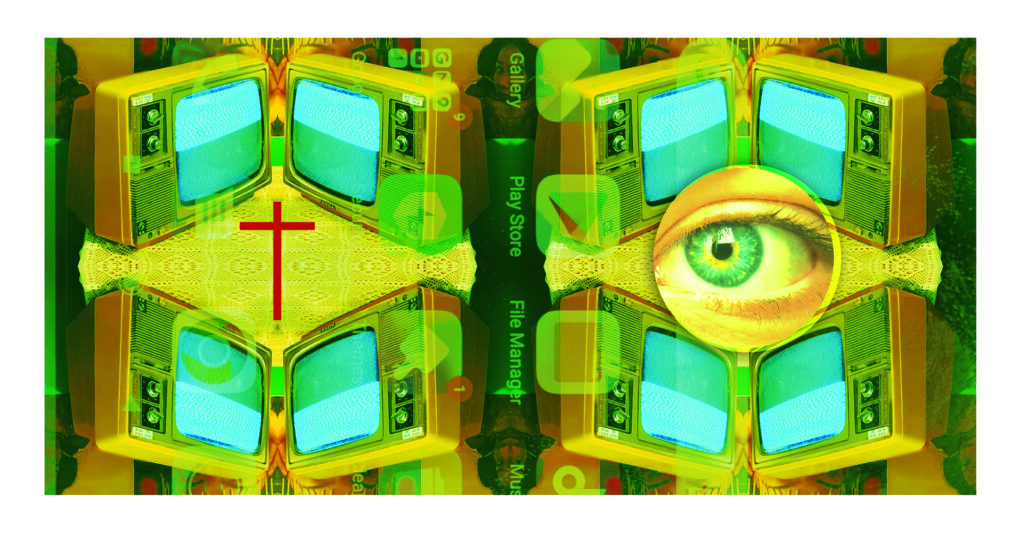
The constant presence of digital screens—with cell phones, tablets, and giant televisions—has become a form of image worship in our modern times. Even in my own home, I hate to admit it, but the screens have become too important. I am often guilty of excessive screen time, spending hours on passive viewing. Ultimately, I realize this time is stolen from my most important commitments. I know all too well that screens and technology can easily become idols. But the Bible is very clear about this topic in both the Old and New Testaments, and it should be avoided. So, if you are in this category too, I completely understand the temptation and the difficulty you also face in restraining yourself from technology. There is, though, a sense of foreknowledge of all of this. As we already know, image worship will occur in the end times, as God said in Revelation 13:14-15. He also said that in the end times people would be a “lover of the self” (2 Timothy 3:1-5). It seems these two topics are related: image worship and self-love.
By covering these topics—“image worship” and “self-love” — with a broad brush, we see this phenomenon manifest in various forms in the modern era, both figuratively and literally. On the one hand, we are constantly in pursuit of validation, with social media “likes” to be worshiped by others. Still, we also have an unhealthy obsession with the image of others, too, as I assume that being a “lover of the self” has personal and societal implications that coincide in the same sphere of image worship. Many worship sports athletes and movie stars in an unhealthy way. If this weren’t the case, they would not grace the covers of all the magazines at the grocery store check-out line. Even well-intentioned followers of Christ may inadvertently fall into this trap. I digress with this personal confession of imbalance in my own life, only to return to the original direction of this writing. This image worship of both ourselves and others, and our collective obsession with screentime, provides a direct line of succession to the antichrist and the worship that will someday be placed on this person.
It is all just one giant rug pull! This is a term from the stock market that describes getting everyone in on a stock and then dumping it once everyone is in (and you are out). But, in this case, no one actually wins anything but an eternity in the fire of hell. At the time of the antichrist, which very well could be one day very soon, everyone will be used to being glued to their screens – conveniently in time for this world-leader to emerge. With this enormous caveat in place, we need to watch our own idolatry so we do not accidentally bestow it on this person. So, you can see the way things are moving towards a singular worship of the beast, and if you do choose to worship this beast, you lose your salvation (Rev. 14:9-11). It is beyond incredibly important that we do not venerate this system or this leader when he emerges on the world’s scene. The concern that I address here in this essay is that we too often use this technology at this juncture, and it is concerning how capable it is of unifying the world someday with this antichrist figure. The means to worship this person is already in place – it is the Internet.
CERN, Apollyon and the Gates of Hell, and the origin of the Internet
The origins of the Internet are inextricably tied to the European Organization for Nuclear Research (CERN) (Bridge, 31 Aug 2015). The Internet was still in its infancy in the early 1990s, and it was then further developed at CERN by a scientist there (World Wide Web Foundation, n.d.). It was initially developed in the 1960s and 1970s by the United States Government (A Brief History of the Internet, n.d.). The development of Hypertext Markup Language (HTML), launched by CERN employee Sir Tim Berners-Lee in 1991, has made information instantly accessible to people worldwide. More than launching the Internet, CERN also contains a Large Hadron Collider, which is said to be the world’s largest underground circular machine (Bridge, 31 Aug, 2015). The goals of CERN include discovering the “God particle” and exploring the origins of life. But these answers are already described in the bible. So, the work they are doing is not groundbreaking. Probably the most curious thing about CERN is its location. CERN is very near, or more likely built over, a community in France that once hosted a temple dedicated to the God Apollo. This community is referenced in Revelation 9:1-2 and 11 as Apollyon, which is described as the opening to the bottomless pit. I speculate widely about CERN, but I presume it has nefarious plans and serves as a gateway — or bridge, of sorts — into the bottomless pit. It is wrapped in a warm cloak of science, but I believe it achieved its goal of commercializing the Internet and is not a science center but rather the gatekeeper for the underworld.
So, the place associated with Apollyon—a doorway to the demonic realm—is the location where the Internet emerged. This circular machine presumably marks the exact spot where this worldwide communication technology was operationalized (not developed) but made usable for the masses. It is also the spot where the Internet really emerged in a usable format. Sure, the intent was not developed initially at CERN but by the United States Government much earlier (Cerf & Aboba, 1993). I digress about the Internet for a moment. Nevertheless, any analysis of end-times prophecy must include the Internet, as its emergence has indeed fulfilled the biblical criteria of providing increased “knowledge”, as described in Daniel 12:4. Like the first Tower of Babel, CERN has gathered people from all over the world in an attempt to reach God’s domain. It also serves other purposes in Revelation, too.
The Internet is a dualistic technology and is used for both good and bad purposes. However, it also makes the application for the mark of the beast found in Revelation chapter 13 possible. It shares lifesaving emergency medical advice but also graphic images. The comparisons between the good and bad uses could go on for hours.
The ease of sharing has been amplified by commercial tools such as Adobe Photoshop, which allow the general public to create and disseminate fictional imagery with unprecedented ease (Messaris, 2012). Given our familiarity with computer-generated imagery (CGI), it is crucial to remember that the biblical “image” of the beast will most likely incorporate artificial intelligence at some level.
Remaining Vigilant
In this age of information, understanding the end-times “warning signs” that technology may represent is important. Since we were instructed in 1 Peter 5:8 to remain vigilant and sober-minded because the devil prowls, seeking death and destruction, we should always be on the lookout.
The enemy capitalizes on new technology because Satan is “of the world” (John 17:14-16) and actively “deceives it in entirety” (Revelation 12:9). We must always be looking for the devil’s plan in our own lives. Since he is technically more competent than we are when we work alone, it is always best to rely on the Holy Spirit and continually ask Him to help us identify areas of our lives where we have an open door. These areas are our idols or things that we have, slowly or unexpectedly, allowed to creep up in importance. Image Worship in the digital age is a big area where many of us, including myself, have allowed ourselves to be placed above God. We need to remain vigilant and keep these idols in check, and be willing to get rid of them if we worship them with our time and talents.

References:
A Brief History of the Internet (n.d.) Retrieved from:https://www.usg.edu/galileo/skills/unit07/internet07_02.phtml#:~:text=Sharing%20Resources,contracts%20with%20the%20Defense%20Department.
Bridge, R., (2015, (Bridge, 31 Aug). 10 mind-blowing facts about the CERN Large Collider you need to know. Retrieved from https://www.rt.com/op-edge/313922-cern-collider-hadron-higgs/
Cerf, V., & Aboba, B. (1993). How the Internet came to be. The On-line User’s Encyclopedia: Bulletin Boards and Beyond. Reading, Massachusetts: Addison-Wesley.
Messaris, P. (2012). Visual “Literacy” in the Digital Age. Review Of Communication, 12(2), 101-117. doi:10.1080/15358593.2011.653508
World Wide Web Foundation (n.d.) History of the Web – World Wide Web Foundation Retrieved from: https://webfoundation.org/about/vision/history-of-the-web/