

Since Jamie Winship’s Living Fearless features so much material, this review was presented in two parts. You can click here to read the first segment. The second half of the book review discusses the following: how Jesus should be our life model, how God speaks to us, and key questions to ask God to foster a closer relationship with Him. The review starts with the central component of confident living, Jesus.
Be like Jesus.
Our Model for life is Jesus (Luke 11:1). Jamie discussed in the book that Jesus modeled “knowing” through continuous dialogue with the Father, and clearly we should do the same. On this topic, Jamie wrote, “Jesus is modeling for humanity the highest level of knowing-asking wisdom from the God who speaks! Think of it from this perspective. Jesus isn’t so much teaching people what to do in a given situation as he is teaching them how to know what to do in every situation-ask and keep on asking, seek and keep on seeking, knock and keep on knocking. Surely the disciples of Jesus had begun to realize that Jesus’s way of knowing was beyond anything they had ever experienced. How did Jesus always seem to know where to go, who to meet, when to start talking, what to say, when to stop talking, when to leave, who to take with him, who to leave behind, who to raise from the dead, when to break Jewish laws, when not to break Jewish laws, and so on? Perhaps this is the motivation in Luke 11:1 when, after seeing Jesus pray (again!) in a certain place, one of the disciples said, ‘Lord, teach us to pray, just like John taught his disciples’ (NIV)” (p. 94-95).
Jesus is modeling for humanity the highest level of knowing-asking wisdom from the God who speaks! Think of it from this perspective. Jesus isn’t so much teaching people what to do in a given situation as he is teaching them how to know what to do in every situation-ask and keep on asking, seek and keep on seeking, knock and keep on knocking. Surely the disciples of Jesus had begun to realize that Jesus’s way of knowing was beyond anything they had ever experienced. How did Jesus always seem to know where to go, who to meet, when to start talking, what to say, when to stop talking, when to leave, who to take with him, who to leave behind, who to raise from the dead, when to break Jewish laws, when not to break Jewish laws, and so on? Perhaps this is the motivation in Luke 11:1 when, after seeing Jesus pray (again!) in a certain place, one of the disciples said, ‘Lord, teach us to pray, just like John taught his disciples’ (NIV) (p. 94-95).
Know who you are talking to.
Another important topic Jamie discusses is the way God sees us. To summarize Jamie’s thoughts on this topic, God sees us as being very special. On page 102, Jamie reminds us that because we are special to Him, God never speaks to us in a derogatory or defamatory way. He only sees us, like David or Moses, in our full and blessed capacity. He does not accuse us like the accuser does (Satan); God does not defame us or hold us captive to what we once did. He speaks to us with clarity, peace, hope, and love, but it cuts through the marrow; it cuts deeply because it is true and authentic, and only His word and truths about ourselves can cut through us, like it says in Hebrews 4:12.
For the word of God is alive and active. Sharper than any double-edged sword, it penetrates even to dividing soul and spirit, joints and marrow; it judges the thoughts and attitudes of the heart.
God uses distinctive verbal phrases to speak with us.
In the book, Jamie teaches that prayer should be novel and relational, not routine and scripted. This is because God does not like prayers that are from memory (p. 96-97). God is concerned with real, relational interactions with us grounded in our everyday life, such as Jamie’s friend Salim. In the book, his friend asked God for help in earning his driver’s license. We have to bring God into our everyday lives and speak with Him about all the decisions we make, because “You have not because you ask not” (James 4:2). As briefly mentioned above, Jamie highlighted a story by his friend Salim in the book. In the story, Salim learned to talk with the Lord; he followed a “nudge” from God and rescued a sick cat during his driving test, which bonded him with the police officer conducting the test. This was particularly important because Salim was from a different race than the police officer, and in his nation, the different races would not ordinarily interact, and they even persecuted people like Salim. Because of Salim’s courage in following the voice of God, he earned his license (p. 97-99, 111-114). Talk with God and follow His leadings.
To learn how to better communicate with God, Jamie offers some really distinctive verbal phrases in the book that he uses to hear God. Based on Jamie’s personal studies of scripture and his life, Jamie has concluded that we should ask God the following questions before every action:
“Should I go?,” (p. 120), “Should I do this?,” (p. 120), “Do you want me to talk to this person?” (p. 121), “Do you want me to go to this village?” (p. 121), “Do you want me to get into the car with those people?” (p. 121), “Will I win?” (p. 121), “When we do this, will it work?” (p. 122), “How should I go?” (p. 122), and “Will I win?” (p. 121).
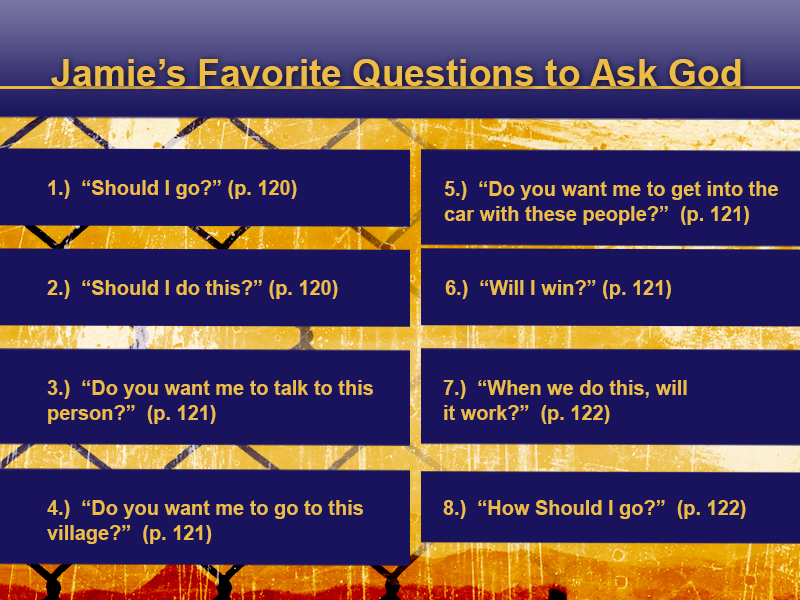
For the distinctive verbal phrase “will I win?” Jamie highlights that the “winning” is associated only with God’s good, perfect, and pleasing will, it is not a “win” in the way that we would always appreciate a “win” (p. 121). Jamie used the illustration of Jesus going to the cross. Winship highlights that this clearly did not look like a win to Peter, and that is why Jesus said “get behind me Satan” to him in scripture, in Matt 16:23. Finally, Jamie stressed that we should never assume that God wants you to speak with every person you meet; you have to ask God about each interaction (p. 121). We have to stay absolutely connected to the Father, and this point was clearly stressed by Jamie throughout the book because it is the true source of our identity.
Pertaining to hearing God, Jamie also specified that hearing and acting are two different things. Jamie concludes that when we hear God, we need to act and also thank Him for His advice. But the hearing and the action are inexplicably tied together and are necessary steps in connecting and growing closer with the Lord. Using scripture as his case study for how to act, Jamie says that Moses heard God, and he acted. Similarly, when God heard the people in these interactions with Moses in that time period, God also acted (p. 103).
Jamie’s advice for business professionals.
Jamie’s application of these questions for business advice was found on page 123 of the book. On this page, Jamie said some friends of his were considering opening a winery. He said they should ask God what to do. God gave them advice, and it was disruptive. It was countercultural as there is a set way for opening and operating a winery. The group followed the advice God gave on opening the winery despite it being counter to the way most wineries operate and do business, and they were very successful and “applauded in the winery culture for its innovation and success” (p. 123).
A summary of my thoughts on Jamie Winship’s Living Fearless book.
At the core of this book is a central theme of one’s God-given authority in Christ. The author, Jamie Winship, illustrates that one’s true identity is often hijacked by “false identities” and lies from the enemy that attempt to alter one’s destiny. By learning effective tools we can use to connect to God directly and hear His voice, we can gain access to our true identity. In Living Fearless, readers also learn about other tools, such as discovering the tactics used by Satan, which encourage the advancement beyond traditional religious structure toward a direct relationship with God. Personally, I learned about the process of discovering my true identity in three specific areas: understanding God’s nature, discovering my true self, and learning how to love my “neighbors,” which is broadly described as close friends or even enemies or radical terrorists. Employing the same tactics of radically loving our neighbors, no matter how different they are, is a transformational activity that Christ used while here on earth.
The book stresses that transformation is also achieved through confession. This topic of confession is also addressed by Dr. Rob Reimer in his Soul Care studies. I encourage readers to check out this link to other writings I have completed about Dr. Reimer because they dovetail nicely with Winship’s ideas on this topic. Like Riemer, Jamie helps readers shift from hearing God’s voice to actively identifying the “spiritual contracts” and dismantling them. Jamie helps readers understand that labeling oneself a “loser” or “unworthy” is not our actual identity in Christ; it is a false identity implemented by Satan to destroy our potential and keep the systemic cycle of bondage, addiction, and isolation going. By silencing demonic voices through real confession, not being apologetic but owning our mistakes, individuals become capable of hearing God’s voice, which will offer a balance of affirmation (e.g., being called “beloved” and or “Loved”) and challenge (e.g., the command to “trust”). This true alignment with the Lord allows us to live a life capable of bold action.
Not surprisingly, Jamie draws heavily from his experiences as a police officer and as a missionary to illustrate how identity dictates our behavior in high-stakes environments. Winship reminds readers that when anyone operates out of a false identity rooted in fear or shame, we will automatically default to a “fight-flight-freeze” mentality. However, when embracing our true identity in Christ, anyone is capable of confronting anyone, including a radical terrorist, and dismantling their hatred with radical love rather than hiding in fear, and therefore deepening the spread of the gospel around the world.
If I could summarize the book in a single core theme, it would be that it focuses on maintaining a continuous dialogue with God. This empowers us all to navigate life and all professional decisions with confidence and success. Winship emphasizes that prayer should be novel and specific rather than rote or memorized, which is solid advice since it is biblically accurate. To help prompt readers to action and connection with the Lord, he provides a framework of distinctive questions. I got so much out of this book, and I hope that everyone gets a chance to read Living Fearless. You can use this link to purchase this book on his website, Identity Exchange. This is really just a small sample of the book; there are many great stories about his travels as a missionary and a police officer, too.


Reference:
Winship, J. (2022). Living Fearless: Exchanging the Lies of the World for the Liberating Truth of God. Baker Books.