

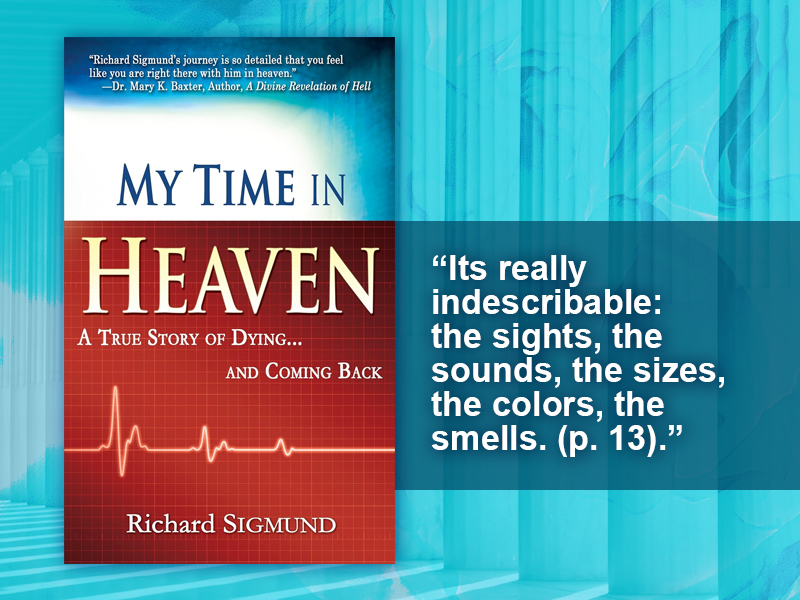
Simply put, My Time in Heaven is an outstanding book. Without sounding overly cliché, everyone should read this book at least once! The story pertains to the actual account of Richard Sigmund and the over eight hours he spent in Heaven on October 17, 1974 (p. 14). You might ask, as I did, how Richard ended up there? The book says Richard Sigmund ended up in Heaven after a sudden, peculiar car accident. The scene apparently looked like two Sherman tanks had hit him. Additional details include that there were no reports of other drivers on the road at the time of the accident. The vehicle he was driving was said to be a rather sturdy “plush luxury van,” so the obscurity of the accident appears to be even more strange (p. 14).
In his first-hand recollection of the accident, God was speaking to him about being a wild horse that needed to be broken at the time of his crash. What can be gleaned about the incident is that it was a supernaturally appointed meeting for Richard to learn about Heaven and to experience Heaven to write this book. As this book has so much content, this is only the first part of a two-part series. I will provide more discourse about additional book details in the next writing, which will include the topics: Information stations, Key People, Children in Heaven, Angels, Jesus, and Father God. I have to say, I have never read a more specific example of a space we cannot readily interact with. The painted picture of Heaven is brimming with details and provides an almost complete overview of Heaven. The splendor, scale and the magnificence of this not-so-distant place above us are accounted for down to the smallest detail in this book. I feel like I am there, and it gives me so much to look forward to!
What is Heaven like?
When Richard first entered Heaven, after his accident, he said a force was drawing him through a glory cloud, which was thick like a cloud, but it was really a “veil” (p. 17), and on the other side of this substance, he could hear people singing. In the new space, there was great joy and total peace. From the perspective in the book, Heaven is a total sensory experience. He saw, sensed, tasted, and even smelled indescribably beautiful aromas. From Richard’s first-hand account, the first taste he had in Heaven was a sort of strawberries and cream flavor. In scripture, in Psalm 34:8, it says “taste and see,” indicating God and by extension His Heaven is very sensory-based – and good. Pertaining to Richard’s experience, when he first entered Heaven, he called this area the “receiving area” of Heaven (p. 17). I don’t want to in any way make it seem like I am joking about his account in Heaven, but the feeling of absolute joy that boils up when reading his text really made me think of the way the movie Willy Wonka and the Chocolate Factory presented a totally joy-inducing space where no sadness or despair could possibly exist. As well, like the movie, Heaven appears to be a completely unique and set apart utopia, which Richard does a good job illustrating this to readers without any illustrations.
When Richard first entered Heaven, after his accident, he said a force was drawing him through a glory cloud, which was thick like a cloud, but it was really a “veil” (p. 17), and on the other side of this substance, he could hear people singing.
In the first chapter, after Richard first gathered his bearings and became aware that he was in Heaven, he noted that he could see other people emerging there as well through “the veil.” People were saying things like “he is coming. I see him, he is coming here, he comes” (p. 17), so apparently, when you first enter Heaven, it is a simultaneous receiving party, and you are not alone. It makes sense too. As we know 3 out of 3 people die, and since so many people exist and die at the same time, this would be a rather busy portal. Coordinated with this understanding, this party of people you once knew on earth can be observed immediately as you are entering Heaven. From his account, when a person first arrives, they appear earthy, for instance, very old, and then suddenly they transform into a younger, healthier, and more vibrant version of oneself, so there was sort of an adjustment to Heavenly perfection that happens upon entry to the space of perfection. Also, in his first recollections there in Heaven, he first saw Jesus. It was very immediate after he saw this receiving party meet the Lord. The interactions he had with Jesus were then continuous throughout his experience in Heaven; however, he was not continually speaking with Jesus. It can already be understood that in Heaven, Jesus is one of the most central beings. As such, Jesus was constantly busy meeting and greeting the residents, hugging, playing, talking, etc. Richard stressed that aside from the magnificence of Heaven, and its overall visual and sensory-based splendor, Jesus is one of the wonders of Heaven and a primary source of beauty there.
In the book, we learn that after entering Heaven, everyone has their own path. Richard said he was taken on his own path through Heaven with two angels. One was on his right and the other on his left. Together, they toured Heaven. They were not alone, as Jesus would also periodically interact with Richard during his visit. The path in Heaven that Richard walked on was golden. And according to Richard, Heaven had the most vibrantly green grass, trees, cities, communities, and flowers of every imaginable size and color. There was also water, banks of water, and roses that looked enormously large. On page 22 of the text, Richard says some of the flowers were the size of a dinner table, stating, “there were roses that looked about four feet across and might’ve weighed fifty pounds on earth. And as I walked, the flowers faced me. The air was filled with their aroma, and they were all humming. I asked if I could pick one to smell, and I was told that I could. It was wonderful. When I put the flower down, it was immediately replanted and growing again. Again, there is no death in Heaven.” Richard said the sky in Heaven is rosette pinkish in color, with a crystal-clear blue backdrop. The clouds in Heaven were all glory clouds. They were made of thousands of angels and people walking in groups and singing in the clouded sky. Apparently, that’s something even the comic strip, The Far Side by Gary Larson, got correct about Heaven!

More details about Heaven, the community’s feel, and an example of a spectacular tree:
One of the consistent themes addressed in Richard’s visit to Heaven was the emphasis he placed on having a large and connected community. In fact, the sense of community, and care for others, is so strong in Heaven that everyone, or at least nearly everyone, is continually preparing for family and friends to arrive. So, I would say, beyond pure and perfect joy that encapsulates Heaven, the land there, comprising the sovereign kingdom nation of Heaven, currently has a theme associated with a growing community. On this topic, on page 23, Richard says people were “having a wonderful time talking with people who had just come through the veil. Others were there in great groups waiting for their loved ones to come through all the people there were in preparation of loved ones coming into heaven.” Like any place, the people there can help make it great.
I guess the entry into Heaven is not a cityscape. It is first rural. So, Richard spoke about the trees, which captured his attention there. Apparently, in Heaven, the trees are tall and beautiful. They contain no dead limbs, which is also consistent with a space filled with no death and no curse whatsoever. On pages 23 to 24, Richard says this about this unique tree he saw in Heaven, “one tree that caught my attention was crystal clear and huge—it seemed to be miles and miles across. I was told that it was a Diadem tree. Each leaf on this tree was the shape of a teardrop, like a crystal chandelier. And there was a continual sound of chimes coming from the leaves as they brushed against one another in the gentle breeze—the beautiful sound of crystal. When I touch them, there was a glow as the sound emanated from them.”
One tree that caught my attention was crystal clear and huge—it seemed to be miles and miles across. I was told that it was a Diadem tree. Each leaf on this tree was the shape of a teardrop, like a crystal chandelier. And there was a continual sound of chimes coming from the leaves as they brushed against one another in the gentle breeze—the beautiful sound of crystal. When I touch them, there was a glow as the sound emanated from them.
Homes in Heaven.
“In my Father’s house are many mansions: if it were not so, I would have told you. I go to prepare a place for you.” John 14:2
Christ specifically says in scripture that there are many mansions in Heaven. Thus, going into this book, knowing scripture, I anticipated some description of Heavenly homes. It was, however, quite interesting to hear there was much description on the topic in this book. From the firsthand perspective, Heaven is comprised of “indescribable architecture” (p. 39). At one point, very early in the book, Richard was particularly awestruck by the large display of outdoor porches on homes in Heaven. He wrote, “many verandas on the second floor, third and even fourth floors.” (p. 27). I think, at this point in the text, he was more surprised by people walking off their upper balcony porches and levitating. So, the emphasis there was more on the lack of gravity laws than on the homes themselves. However, later in the book, in chapter 5, there was an entire section written on Heavenly dwellings. We’re talking about huge avenues that appear to be two hundred and fifty feet wide and extending for miles and miles with beautiful golden and crystal streets that were made out of precious stones, gold, and silver. In Heaven, according to Richard, there are vast cities and rows upon rows of millionaires’ mansions (that we would consider here on earth). Of course, these homes are associated with the vast riches bestowed on those who spent their time on earth ministering to the very poor and destitute. Often living destitute lives themselves with a focus on “missions minded people” (p. 38).
A unique description of a mansion was for a person named Pearl. The description for the home included, “It was a single mansion carved out of a single, giant pearl. The house seemed to be 250 to 300 feet across and 100 feet tall. The furniture inside had been formed by angels who had molded and carved the pearl into its shape. Even the chandelier had been carved out of the pearl, and it was lit. It glowed from within. The house was made of pearls belonging to a woman named Pearl, and the angels told me her story. She had been a missionary known, for giving to the poor. Eventually, she had died of starvation. The house of pearl was a reward for her pure heart” (p. 38). Apparently, and without surprise, the most magnificent residences are for those who gave all for the Gospel in their life on earth.
It was a single mansion carved out of a single, giant pearl. The house seemed to be 250 to 300 feet across and 100 feet tall. The furniture inside had been formed by angels who had molded and carved the pearl into its shape. Even the chandelier had been carved out of the pearl, and it was lit. It glowed from within. The house was made of pearls belonging to a woman named Pearl, and the angels told me her story. She had been a missionary known, for giving to the poor. Eventually, she had died of starvation. The house of pearl was a reward for her pure heart (p. 38).
Everything in Heaven is uniquely alive, even the buildings. In the book, Richard says he put his ear up to a structure, and it was producing a humming sound that was the most beautiful song he had ever heard, giving praise to the Lord. Like the structure, everything in Heaven was alive. It sounded a lot like the movie Avatar, but real and about God. Everything was made by Him (John 1:3) and pointed to Him. In fact, all the structures, waterways, walkways, forested areas, everything points to the throne of God, Jesus, and the Holy Spirit. Like the movie Avatar, in Heaven there are floating cities made of light, giving off “rays of glory that shone brighter than any earthly sun ever could” (p. 41). On a final note about Heavenly architecture, there is a community plan associated with its design. As it appears to group together communities of personal connection on earth. Richard says, “I saw many homes on the street for people whom I loved and who loved me,” theorizing that familiarity is a grouping system in Heaven (p. 43).
Conclusion: I hope everyone reads this book at least once!
Richard Sigmund’s My Time in Heaven offers a rich description that is more than a simple memoir; it is a vivid map of things to come. By blending scriptural promises with his experiential details, Sigmund grounds the account in scriptural truth and makes it even more convincing to any skeptical reader. His account of the “receiving party” and the intentional community of loved ones reframes death not as a departure, but a homecoming. Whether one approaches the text as a Bible-believing reader or a curious seeker, it is difficult to ignore the profound sense of hope and curiosity that emerges from the pages. In closing, this book stands as a powerful testament to the eternal permeance of the Bible and its truths. My Time in Heaven is much more than a standard book; it is a transformative journey that encourages us to live with our eyes fixed on Heaven.

Reference:
Sigmund, R. (2009). My time in Heaven. Whitaker House.